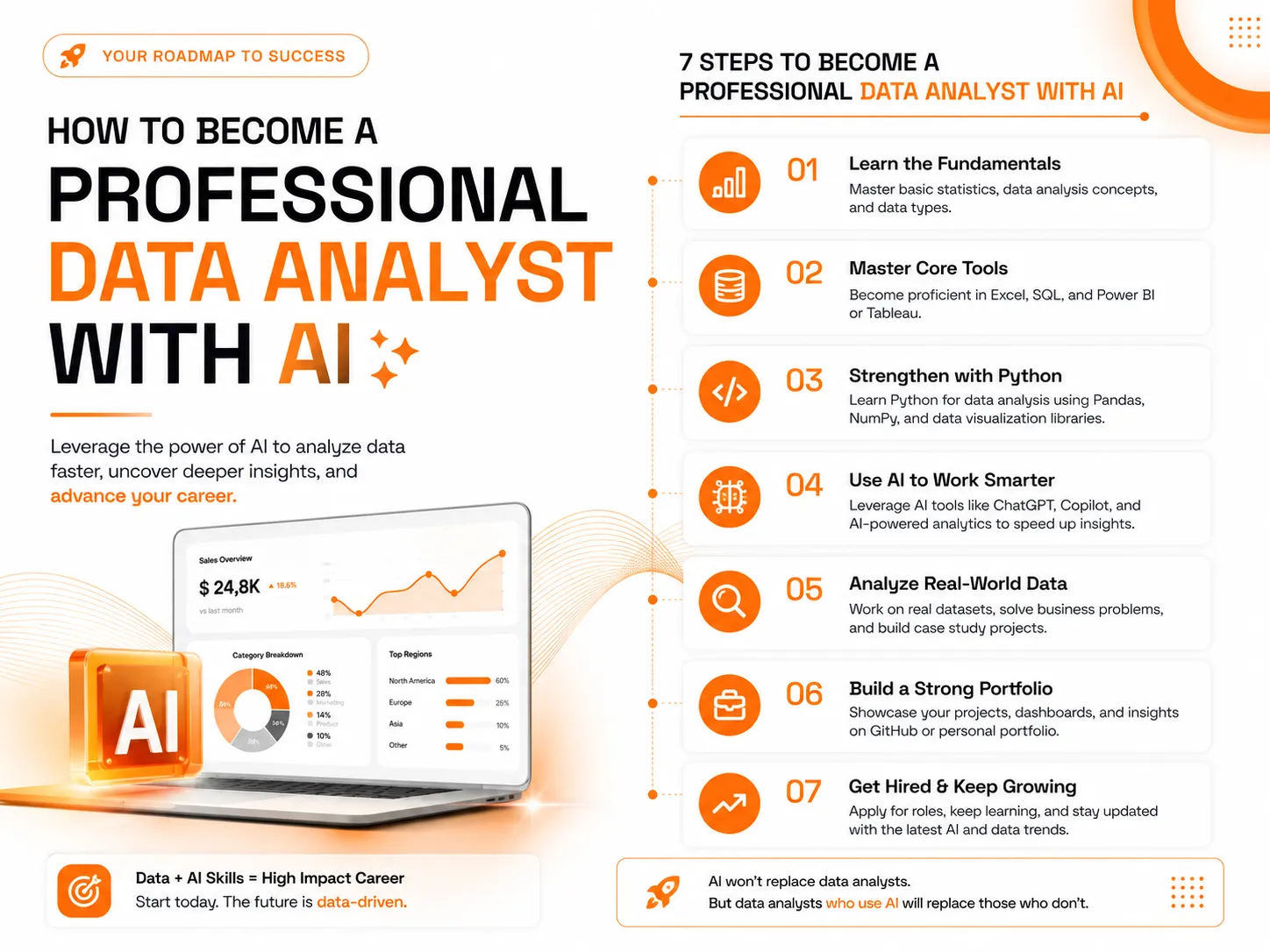
The role of a Data Analyst has evolved dramatically with Artificial Intelligence (AI). Today's analysts are no longer spending hours manually cleaning data, writing repetitive SQL queries, or creating reports from scratch. AI-powered tools now automate many repetitive tasks, allowing analysts to focus on business insights, decision-making, and strategy.
If you want to become a professional Data Analyst in 2026, learning AI alongside traditional analytics skills is no longer optional—it is essential. The future belongs to AI-powered analysts who can combine analytical thinking with modern AI tools.
What Does a Data Analyst Do?
A Data Analyst collects, cleans, analyzes, and visualizes data to help organizations make better business decisions. Data analysts transform raw data into actionable insights that improve sales, marketing, operations, finance, and customer experiences.
Main Responsibilities
Collecting data from multiple sources
Cleaning and preparing datasets
Analyzing trends and patterns
Creating dashboards and reports
Building visualizations
Presenting insights to stakeholders
Supporting business decisions using data
Step 1: Learn Statistics and Mathematics
Mathematics is the foundation of data analysis. You do not need advanced calculus, but you must understand:
Mean, Median, Mode
Probability
Standard Deviation
Variance
Correlation
Hypothesis Testing
Regression Analysis
Sampling Techniques
A/B Testing
Statistics helps you understand whether patterns in data are meaningful or simply random. Professional analysts use statistics daily when making recommendations.
Step 2: Master Microsoft Excel
Excel remains one of the most important tools in analytics. Many businesses still rely heavily on spreadsheets for reporting and decision-making.
Skills to Learn
Pivot Tables
XLOOKUP
INDEX MATCH
Conditional Formatting
Power Query
Data Cleaning
Charts and Dashboards
Excel is often the starting point for many analytics projects.
Step 3: Learn SQL (Most Important Skill)
SQL is the language of data. Almost every company stores data inside databases. A professional Data Analyst must be comfortable extracting information using SQL.
Topics to Master
SELECT Statements
WHERE Conditions
GROUP BY
ORDER BY
JOINS
Subqueries
Window Functions
CTEs
Stored Procedures
Companies often consider SQL proficiency more important than programming skills for analyst positions.
Step 4: Learn Python for Analytics
Python is one of the most valuable skills for modern analysts. It allows you to automate workflows, analyze large datasets, and perform advanced analytics.
Python Libraries
Pandas
NumPy
Matplotlib
Seaborn
Plotly
Scikit-Learn
Use Cases
Data Cleaning
Automation
Data Visualization
Predictive Analytics
Machine Learning
Step 5: Master Data Visualization
Data without visualization is difficult to understand. Analysts must communicate findings clearly to decision-makers.
Top Visualization Tools
Power BI
Tableau
Looker Studio
Excel Dashboards
The goal is not simply creating charts but telling a story through data.
Step 6: Learn AI for Data Analysis
This is where modern analysts gain a competitive advantage. AI dramatically increases productivity and reduces repetitive work.
Popular AI Tools for Data Analysts
ChatGPT
Claude
Gemini
Microsoft Copilot
Power BI Copilot
Tableau AI
Julius AI
Pandas AI
How AI Helps Data Analysts
Generate SQL queries instantly
Write Python code faster
Automate documentation
Summarize datasets
Create dashboards quicker
Generate reports automatically
Identify trends and anomalies
Speed up exploratory data analysis
AI can automate many repetitive tasks that traditionally consumed large portions of an analyst's day. Industry research consistently shows that AI significantly improves analyst productivity while allowing professionals to focus on higher-value work.
Will AI Replace Data Analysts?
This is one of the most common questions in the industry. The short answer is:
No, AI Will Not Replace Professional Data Analysts.
AI can automate repetitive tasks such as:
Data Cleaning
Basic Reporting
SQL Generation
Dashboard Creation
Data Summaries
However, AI still struggles with:
Business Context
Strategic Thinking
Stakeholder Communication
Problem Framing
Decision Making
Data Governance
Critical Thinking
Research and industry experts indicate that AI is more likely to augment analysts than replace them. The analyst's role is shifting from producing reports to interpreting insights, asking better questions, and guiding business decisions.
The future is not:
AI vs Data Analyst
The future is:
AI + Data Analyst
How AI Saves Data Analysts Hundreds of Hours
Task | Traditional Time | With AI |
|---|---|---|
SQL Query Writing | 30 Minutes | 5 Minutes |
Data Cleaning | 4 Hours | 1 Hour |
Dashboard Creation | 1 Day | 2 Hours |
Report Writing | 3 Hours | 20 Minutes |
Documentation | 2 Hours | 10 Minutes |
Many organizations are adopting AI because it dramatically reduces time spent on research, reporting, and repetitive analysis work.
Build a Strong Portfolio
A portfolio is often more important than certifications. Recruiters want proof that you can solve real-world problems.
Portfolio Project Ideas
Sales Dashboard Analysis
E-commerce Analytics
Customer Churn Prediction
Marketing Campaign Analysis
Financial Performance Dashboard
HR Analytics Dashboard
AI-Powered Business Intelligence Project
Best Certifications
Google Data Analytics Certificate
Microsoft Power BI Data Analyst
IBM Data Analyst Professional Certificate
SQL Certifications
Python for Data Science
Azure Data Fundamentals
AWS Data Analytics
Career Roadmap
Follow this sequence:
Statistics & Mathematics
Excel
SQL
Python
Power BI / Tableau
AI Tools
Machine Learning Basics
Portfolio Projects
Internship / Freelancing
Professional Data Analyst Role
Final Thoughts
The demand for Data Analysts remains strong, but the role is changing. Companies increasingly seek professionals who can combine data expertise with AI-powered productivity.
Instead of worrying about AI replacing analysts, focus on becoming an AI-powered analyst. Learn statistics, SQL, Python, Power BI, business thinking, and AI tools. The professionals who adapt to AI will be significantly more valuable than those who ignore it.
The future belongs to analysts who can transform data into decisions faster, smarter, and more effectively using AI.