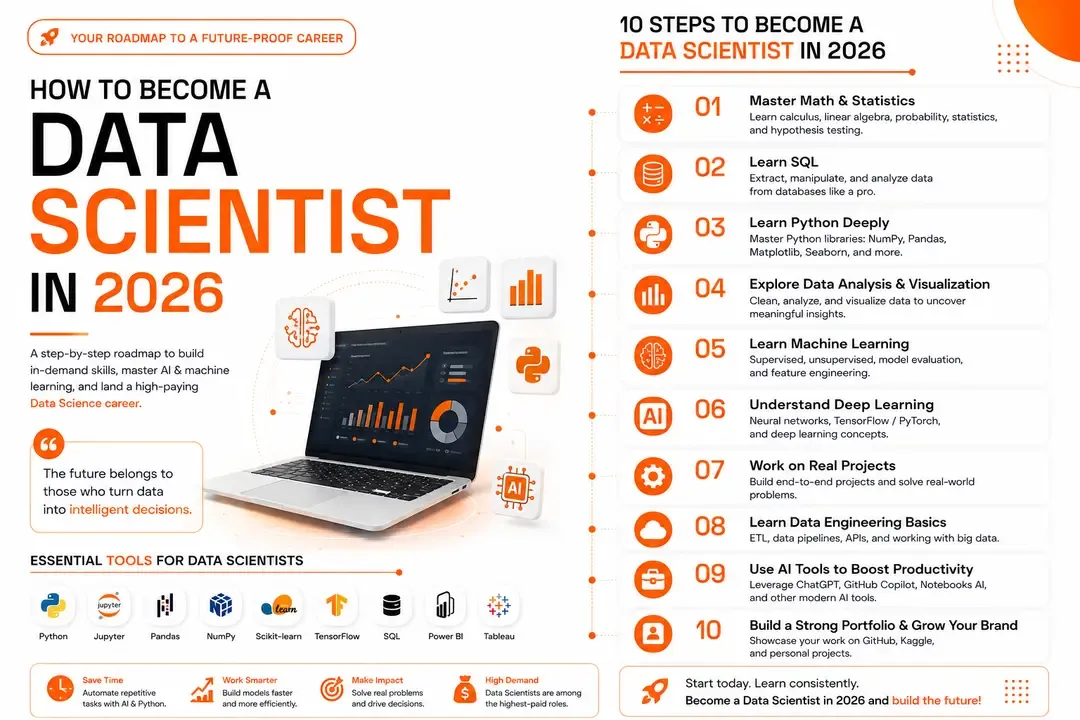
Data Science is one of the fastest-growing and highest-paying careers in the technology industry. From healthcare and finance to e-commerce, cybersecurity, robotics, and artificial intelligence, companies generate enormous amounts of data every day. The professionals who can collect, analyze, understand, and build intelligent systems from this data are known as Data Scientists.
In 2026, becoming a Data Scientist is no longer just about learning Python or Machine Learning. The role has evolved significantly due to Artificial Intelligence, Large Language Models (LLMs), Generative AI, cloud computing, and automated machine learning platforms. Today's Data Scientists combine mathematics, statistics, programming, domain knowledge, communication skills, and AI tools to solve real-world business problems.
If you're starting from scratch, don't worry. This guide is designed to take you from beginner to professional by explaining each concept in simple language, recommending the best tools, libraries, learning strategies, and projects to build your career.
What is Data Science?
Data Science is the field of extracting useful information and knowledge from structured and unstructured data using mathematics, statistics, programming, machine learning, and artificial intelligence.
Instead of simply creating reports, Data Scientists build predictive models that help businesses make intelligent decisions.
Examples include:
Netflix recommending movies.
Amazon suggesting products.
Google Translate understanding languages.
ChatGPT generating human-like conversations.
Uber predicting ride demand.
Banks detecting fraud.
Hospitals predicting diseases.
Self-driving cars recognizing roads.
Every one of these systems uses Data Science.
Who is a Data Scientist?
A Data Scientist is someone who combines programming, mathematics, statistics, machine learning, artificial intelligence, and business understanding to solve complex problems using data.
A professional Data Scientist spends time:
Collecting datasets
Cleaning messy data
Analyzing patterns
Creating predictive models
Building machine learning algorithms
Visualizing results
Explaining findings to business teams
Deploying AI models into production
Why Choose Data Science in 2026?
Data Science continues to be one of the most valuable technology careers because organizations rely on data-driven decisions more than ever before.
Reasons to choose Data Science:
High salary opportunities
Global demand
Remote work options
Freelancing opportunities
AI-powered career growth
Continuous learning
Works across every industry
Future-proof profession
Data Scientist vs Data Analyst vs Machine Learning Engineer
Role | Main Focus | Programming | Machine Learning |
|---|---|---|---|
Data Analyst | Create dashboards and business reports | Basic Python & SQL | Low |
Data Scientist | Predict future outcomes using AI | Advanced Python | High |
Machine Learning Engineer | Deploy AI models into production | Expert Programming | Very High |
The Complete Data Scientist Roadmap
Learn Programming Fundamentals
Master Python
Study Mathematics
Learn Statistics
Master SQL
Learn Data Cleaning
Data Visualization
Machine Learning
Deep Learning
Generative AI
Large Language Models
Data Engineering Basics
MLOps
Cloud Computing
Portfolio Building
GitHub
Kaggle Competitions
Interview Preparation
Freelancing
Landing Your First Job
Skills Every Professional Data Scientist Needs
Critical Thinking
Problem Solving
Python Programming
SQL
Mathematics
Statistics
Machine Learning
Deep Learning
Artificial Intelligence
Data Visualization
Cloud Platforms
Communication Skills
Business Understanding
Version Control (Git)
Linux Basics
Docker
APIs
Generative AI
Prompt Engineering
Do You Need a Computer Science Degree?
No. Many successful Data Scientists come from mathematics, engineering, economics, finance, physics, biology, and even non-technical backgrounds.
What matters most today is your ability to solve real problems, build projects, understand machine learning concepts, and demonstrate practical skills through a strong portfolio.
Can Beginners Become Data Scientists?
Absolutely. Every professional Data Scientist started as a beginner. The biggest mistake beginners make is trying to learn everything at once. Instead, focus on mastering one topic at a time and building projects as you learn.
Consistency is far more important than speed. Studying one to two hours every day for a year will usually lead to better long-term results than trying to learn everything in a few weeks.
What You Will Learn in This Complete Guide
In the next sections, you'll learn:
The mathematics behind AI and machine learning.
Python libraries every Data Scientist uses.
How Machine Learning works.
Deep Learning explained simply.
How ChatGPT/Claude/Gemini and LLMs work.
How AI can increase your productivity.
How to create impressive portfolio projects.
How to learn efficiently without feeling overwhelmed.
Common beginner mistakes and how to avoid them.
Interview preparation and career advice.
A complete roadmap from beginner to professional Data Scientist.
Let's start by building the strongest foundation: mathematics and statistics, the core subjects behind every successful AI model and machine learning algorithm.