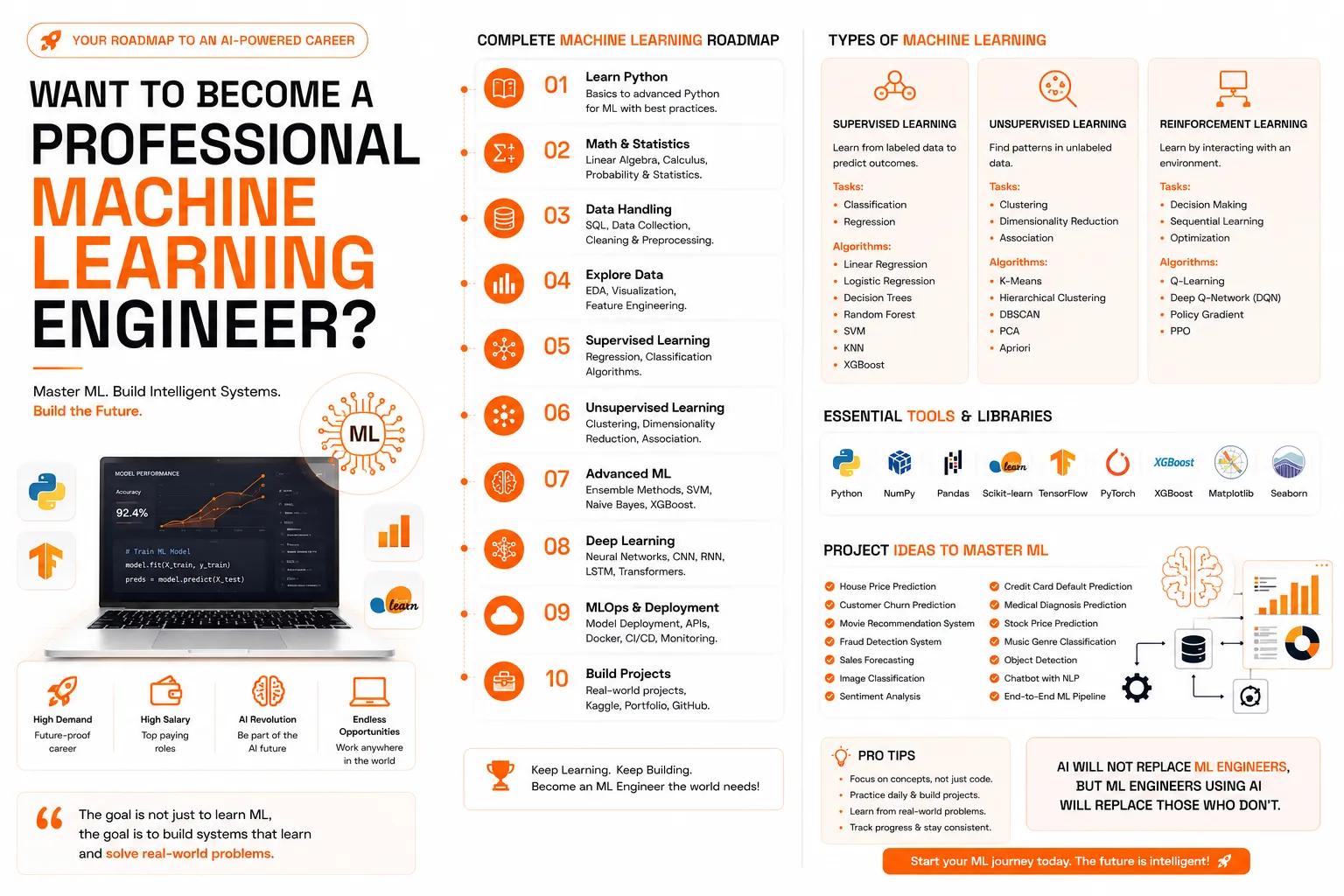
Machine Learning (ML) is one of the fastest-growing fields in Artificial Intelligence (AI). It enables computers to learn from data, identify patterns, and make predictions without being explicitly programmed. ML powers recommendation systems, fraud detection, self-driving cars, medical diagnosis, chatbots, image recognition, and much more.
What is Machine Learning?
Machine Learning is a branch of Artificial Intelligence that uses data and algorithms to train computers to make intelligent decisions. Instead of writing rules manually, a Machine Learning model learns from examples.
Example
Imagine teaching a child to recognize cats by showing thousands of cat pictures. Eventually, the child learns the pattern and recognizes new cats. Machine Learning works in a similar way by learning from datasets.
Machine Learning vs Artificial Intelligence vs Deep Learning
Technology | Description |
|---|---|
Artificial Intelligence | Creates intelligent systems capable of performing human-like tasks. |
Machine Learning | Allows computers to learn from data automatically. |
Deep Learning | Uses neural networks with multiple layers to solve complex problems. |
Complete Roadmap
Learn Python
Master Mathematics
Learn Statistics
Master SQL
Learn Data Analysis
Master Python Libraries
Understand Machine Learning Algorithms
Learn Deep Learning
Understand AI & LLMs
Build Projects
Deploy Models
Create Portfolio
Mathematics Required
Linear Algebra
Calculus
Probability
Statistics
Optimization
Mathematics helps Machine Learning models understand patterns, optimize predictions, and reduce errors.
Statistics Topics
Mean
Median
Mode
Variance
Standard Deviation
Correlation
Hypothesis Testing
Bayes Theorem
Programming Language
Python is the most popular language for Machine Learning because it is simple, powerful, and has an excellent ecosystem.
Essential Python Libraries
Library | Purpose |
|---|---|
NumPy | Numerical computing and arrays |
Pandas | Data manipulation and cleaning |
Matplotlib | Charts and visualization |
Seaborn | Statistical visualization |
Plotly | Interactive dashboards |
Scikit-learn | Machine Learning algorithms |
TensorFlow | Deep Learning |
PyTorch | Neural Networks and AI research |
XGBoost | High-performance boosting algorithm |
LightGBM | Fast gradient boosting |
OpenCV | Computer Vision |
NLTK / spaCy | Natural Language Processing |
Types of Machine Learning
1. Supervised Learning
Uses labeled data to predict outputs.
Examples:
House Price Prediction
Spam Email Detection
Credit Risk Prediction
Algorithms:
Linear Regression
Logistic Regression
Decision Tree
Random Forest
Support Vector Machine
K-Nearest Neighbors
XGBoost
2. Unsupervised Learning
Uses unlabeled data to discover hidden patterns.
Examples:
Customer Segmentation
Market Basket Analysis
Anomaly Detection
Algorithms:
K-Means
DBSCAN
Hierarchical Clustering
PCA
3. Semi-Supervised Learning
Uses a small amount of labeled data and a large amount of unlabeled data to improve learning.
4. Reinforcement Learning
An agent learns by interacting with an environment and receiving rewards or penalties.
Examples:
Robotics
Self-driving Cars
Game AI
Deep Learning
Deep Learning uses Artificial Neural Networks with multiple hidden layers to solve complex problems.
Main Architectures:
Artificial Neural Networks (ANN)
Convolutional Neural Networks (CNN)
Recurrent Neural Networks (RNN)
LSTM
Transformers
How AI Works
Artificial Intelligence combines Machine Learning, Deep Learning, and large datasets to perform intelligent tasks. AI models learn from millions of examples and improve their predictions over time.
For example, a recommendation system analyzes your previous purchases and predicts products you may like next.
How AI Helps Machine Learning Engineers
Generate Python code
Write SQL queries
Debug programs
Create documentation
Explain algorithms
Generate datasets
Build models faster
Automate repetitive tasks
Best AI Tools
Claude
Chatgpt
Gemini
GitHub Copilot
Cursor AI
NotebookLM
Jupyter Notebook
Model Development Workflow
Collect Data
Clean Data
Analyze Data
Feature Engineering
Select Algorithm
Train Model
Evaluate Model
Tune Hyperparameters
Deploy Model
Monitor Performance
Project Ideas
Spam Detection
Movie Recommendation System
House Price Prediction
Stock Price Forecasting
Customer Churn Prediction
Credit Card Fraud Detection
Face Recognition
Handwritten Digit Recognition
Chatbot
Resume Screening AI
Common Beginner Mistakes
Skipping mathematics
Ignoring statistics
Copying projects without understanding
Learning too many libraries at once
Not building a portfolio
Avoiding Git and GitHub
Not practicing regularly
How to Master Machine Learning
Practice Python daily
Solve real datasets
Participate in Kaggle competitions
Build projects
Read research papers
Contribute to open-source projects
Create a GitHub portfolio
Use AI tools to learn faster, not to replace understanding
Career Opportunities
Machine Learning Engineer
AI Engineer
Data Scientist
Computer Vision Engineer
NLP Engineer
MLOps Engineer
Research Scientist
Final Thoughts
Machine Learning is more than learning algorithms. It requires strong fundamentals in mathematics, programming, data analysis, and problem-solving. Start with Python, understand statistics and linear algebra, master essential libraries like NumPy, Pandas, Scikit-learn, TensorFlow, and PyTorch, build real-world projects, and use AI tools to accelerate your workflow. With consistent practice and a strong portfolio, you can become a professional Machine Learning Engineer in 2026.