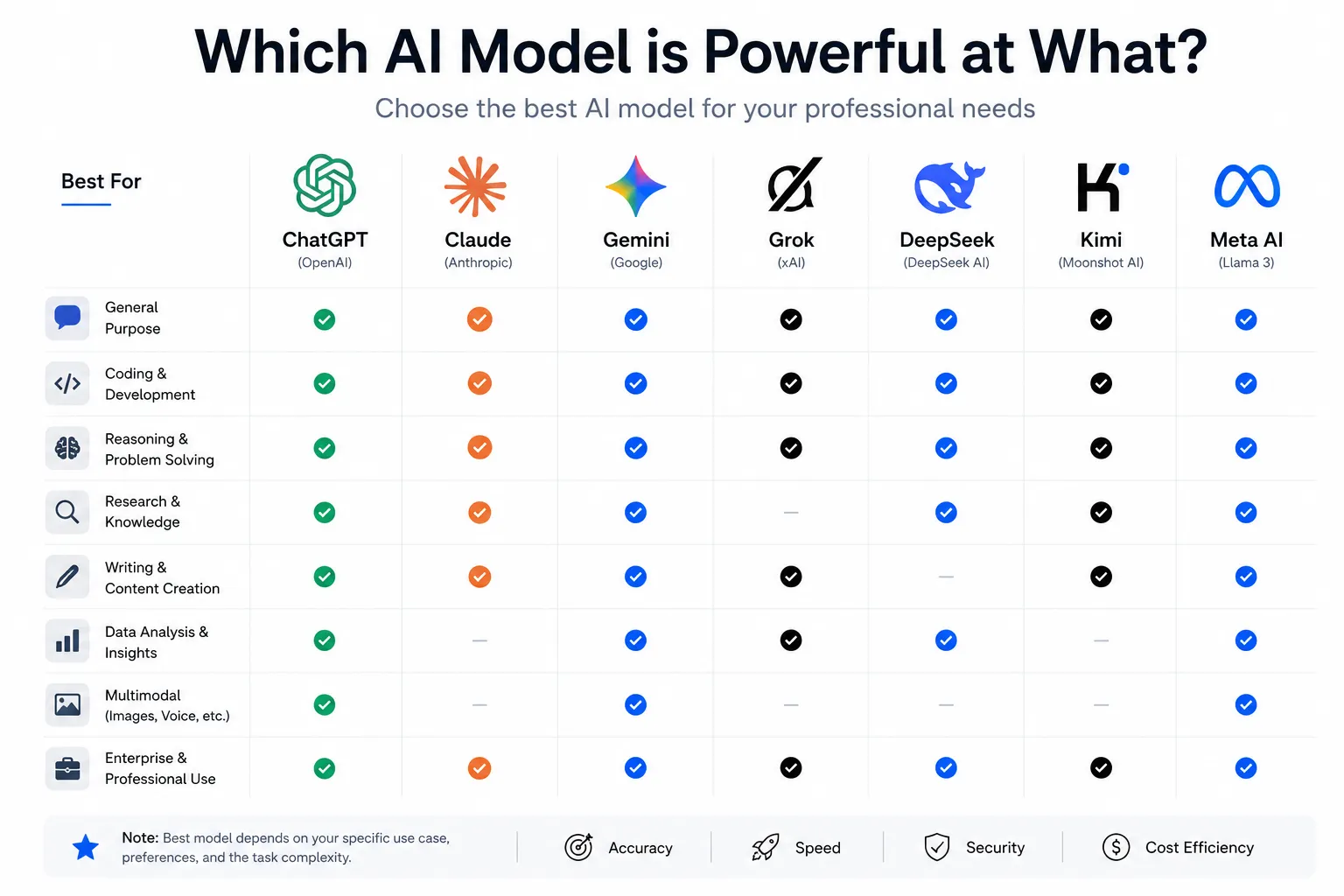
The AI landscape in 2026 has shifted from single all-purpose models to highly specialized tools. Choosing the right AI requires understanding precise version capabilities across coding, reasoning, data analysis, and multimodal tasks. Below is an exhaustive, fact-based breakdown of the frontier models, their specific versions, and their performance metrics, fully aligned with the data shown in the provided visual reference, which ai is best for what.png.
Analysis of which ai is best for what.png
The reference image provides a foundational matrix of AI capabilities. Here is the exact breakdown of what each model supports based on the visual:
ChatGPT (OpenAI): Checked across all categories: General Purpose, Coding & Development, Reasoning & Problem Solving, Research & Knowledge, Writing & Content Creation, Data Analysis & Insights, Multimodal, and Enterprise & Professional Use.
Claude (Anthropic): Checked for General Purpose, Coding & Development, Reasoning & Problem Solving, Research & Knowledge, Writing & Content Creation, and Enterprise. It lacks native support (marked with a dash) for Data Analysis & Insights and Multimodal.
Gemini (Google): Checked for all categories, mirroring ChatGPT as a comprehensive multimodal and analytical system.
Grok (xAI): Checked for General Purpose, Coding, Reasoning, Writing, Data Analysis, and Enterprise. It lacks Research & Knowledge and Multimodal capabilities in this specific matrix.
DeepSeek (DeepSeek AI): Checked for General Purpose, Coding, Reasoning, Research, Data Analysis, and Enterprise. It lacks Writing & Content Creation and Multimodal.
Kimi (Moonshot AI): Checked for General Purpose, Coding, Reasoning, Research, Writing, and Enterprise. It lacks Data Analysis and Multimodal.
Meta AI (Llama 3 / 4): Checked across all categories, serving as a comprehensive open-weight enterprise solution.
The 2026 AI Contenders: Detailed Model Versions and Specifications
1. Anthropic: The Claude 4 Series
Anthropic's 2026 lineup is heavily optimized for architectural software engineering, long-horizon agents, and rigorous reasoning.
Claude Opus 4.8: The strongest released model for complex logic and software engineering. It leads the SWE-bench Verified benchmarks in the high 80s. It handles multi-file codebase refactoring with a 1-million token context window. It is the definitive choice for building secure backend systems, database structuring, and API orchestration.
Claude Sonnet 4.6: The high-efficiency variant. It offers 98% of Opus's capability at a fraction of the cost, making it the industry standard for daily, high-volume production automations and continuous CI/CD integration tasks.
Claude Mythos Preview: An unreleased proprietary model currently topping raw reasoning leaderboards with a score of 72.5. It is not yet available for production stacks.
2. OpenAI: The GPT-5 Series
OpenAI continues to dominate the generalist and orchestration layer, providing highly versatile models for diverse business integrations.
GPT-5.5: The ultimate all-rounder. It features a 1.1-million token context window. It excels at agentic workflows, natural prose generation, and deep tool integrations. It is particularly effective for generating full-stack UI frontend implementations and executing strict JSON formatting for data pipelines.
GPT-5.1 Codex-Max: A specialized variant built specifically for API-heavy development, architecture planning, and producing production-ready functions with minimal hallucinations.
3. Google: The Gemini 3 Series
Google's models lead in massive data ingestion, native multimodal processing, and cost-to-performance ratios at the frontier level.
Gemini 3.1 Pro: Features a massive 1M to 2M token context window. It is the undisputed leader for deep academic reasoning, long-document research, and cross-file repository analysis. It processes text, audio, image, and video natively.
Gemini 3.5 Flash: A highly affordable model optimized for speed and high-throughput tasks, available at roughly $0.78 per 1M tokens.
4. DeepSeek AI: The V4 Series
DeepSeek has disrupted the market by offering proprietary-level performance at open-source costs.
DeepSeek V4 Pro: An 820B parameter MoE model that achieves frontier-level coding performance. It is extremely cost-sensitive, priced well under $1 per million tokens. It matches top-tier models in autonomous bug fixing and Python/Next.js script generation.
DeepSeek V4 Flash: A faster, efficiency-optimized 284B parameter variant designed for maximum inference speed in high-throughput workloads.
5. xAI: The Grok 4 Series
xAI focuses on unfiltered real-time data synthesis and ultra-fast inference.
Grok 4.3: A reasoning-first model that processes at roughly 200 tokens per second. It integrates live social data and natively supports video inputs. It is the fastest model for real-time market analysis and agentic reasoning on a budget.
6. Meta AI: The Llama 4 Series
Meta provides the foundation for self-hosted, sovereign AI deployments.
Llama 4 Scout: This open-weight model supports an unprecedented 10-million token context window. It is the absolute winner for enterprises requiring total data privacy, allowing teams to run massive context models directly on secure local hardware.
7. Moonshot AI: Kimi
A highly efficient option for document-heavy workflows.
Kimi K2.6: Supports up to 262K tokens and delivers exceptional reasoning with a 90.5% GPQA score. At $1.29 per 1M tokens, it is highly capable for long-document research and agentic tool use.
Category Winners: Which AI Wins in What?
Based on mid-2026 empirical benchmarks, here are the definitive winners for every category:
Best AI for Coding & Software Development: Claude Opus 4.8 wins for complex, multi-file software engineering, secure system architecture, and long-horizon debugging. DeepSeek V4 Pro wins for the best value and open-weight API coding.
Best AI for Thinking & Complex Reasoning: Claude Mythos Preview leads in pure reasoning scores. Gemini 3.1 Pro wins among released models for processing massive datasets and deep scientific problem-solving.
Best AI for General Chat & Tool Orchestration: GPT-5.5 wins comprehensively due to its consistency, broad ecosystem integrations, and seamless user experience.
Best AI for Writing & Content Creation: GPT-5.5 wins for structured long-form writing. Claude Opus 4.8 (and Sonnet 4.6) produces the most natural, human-like prose and maintains a strict professional tone.
Best AI for Multimodal (Images, Video, Audio): Gemini 3.1 Pro wins for native video and massive audio analysis. For pure image composition and generation, specialized models like Qwen-Image and Nano Banana 2 dominate over standard text models.
Best AI for Data Analysis & Research: Gemini 3.1 Pro wins for analyzing long context (financial reports, massive JSON datasets).
Best AI for Enterprise & Local Deployment: Llama 4 Scout wins for absolute secure, offline, self-hosted environments.
Comprehensive 2026 Model Comparison Table
Model Name | Developer | Context Window | Pricing Estimate (per 1M tokens In/Out) | Primary Strength / Winning Category |
|---|---|---|---|---|
Claude Opus 4.8 | Anthropic | 1,000,000 | ~$5.00 / ~$25.00 | Advanced Agentic Coding, Secure Architecture, Complex Reasoning |
GPT-5.5 | OpenAI | 1,100,000 | ~$5.00 / ~$30.00 | Generalist Tasks, Writing, UI Implementation, Tool Use |
Gemini 3.1 Pro | 1,000,000 - 2,000,000 | ~$2.00 / ~$12.00 | Multimodal Video/Audio, Deep Academic Reasoning, Large Datasets | |
Grok 4.3 | xAI | 1,000,000 (Fast tier 2M) | ~$1.25 / ~$2.50 | Real-Time Data Synthesis, High-Speed Inference, Social Data |
DeepSeek V4 Pro | DeepSeek AI | 1,000,000 | Well under $1.00 / ~$1.00 | Cost-Efficient Software Development, High-Volume Automation |
Kimi K2.6 | Moonshot AI | 262,000 | ~$1.29 (Blended) | Document Research, High-Value Reasoning Workflows |
Llama 4 Scout | Meta AI | 10,000,000 | Self-Hosted (Infrastructure Cost Only) | Complete Data Privacy, Massive Context Scale, Offline Enterprise Use |
Practical Conclusion for Professional Deployment
In the modern development stack, relying on a single AI model is inefficient. Professional workflows now utilize orchestration layers to route tasks intelligently: routing backend logic and secure database structural queries to Claude Opus 4.8, processing massive SEO datasets or server logs with Gemini 3.1 Pro, and handling standard UI component generation with GPT-5.5 or DeepSeek V4 Pro. The winner is determined strictly by the specific technical requirement and security mandate of the task at hand.