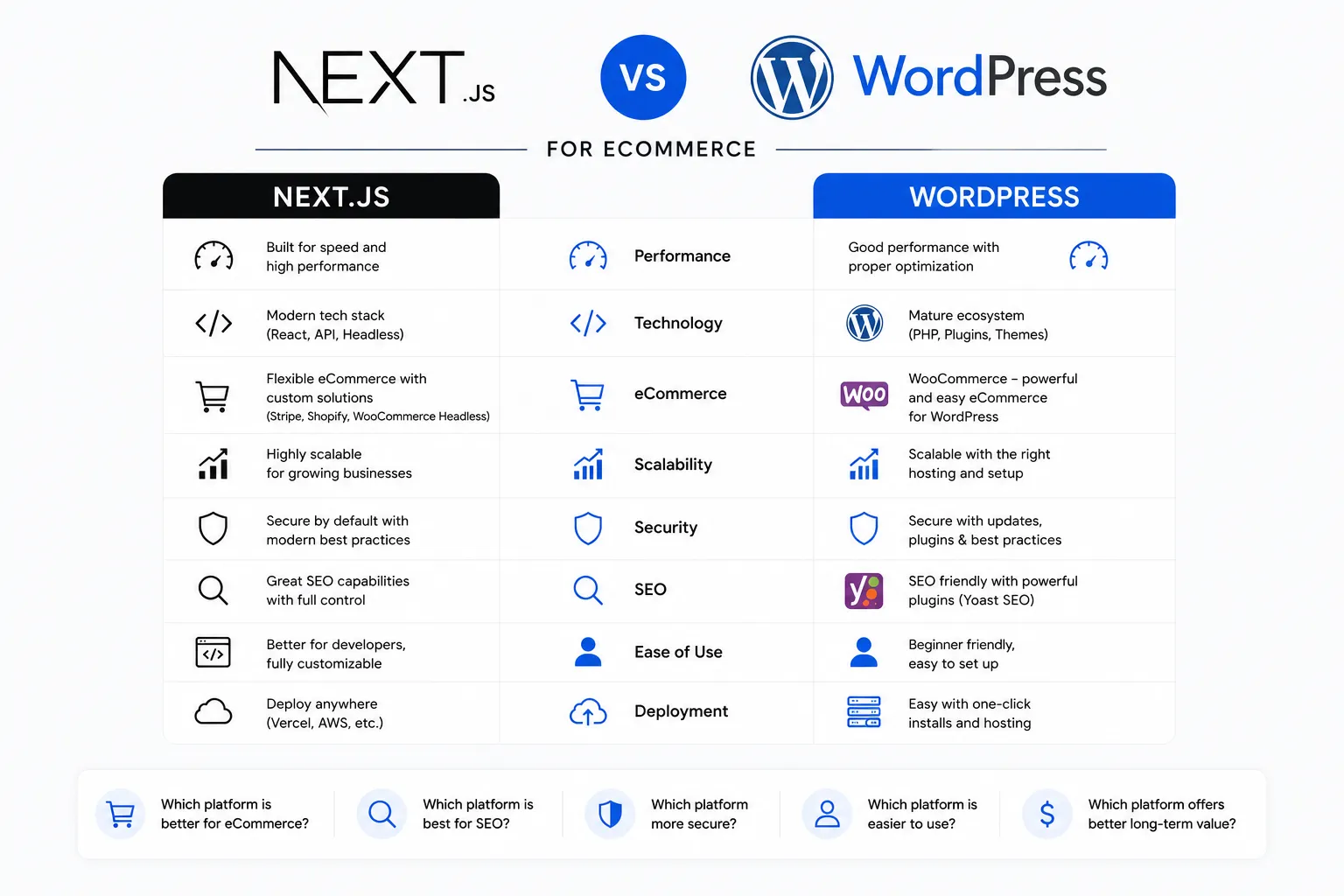
WooCommerce vs Next.js Commerce (2026): The Ultimate Architecture Comparison
The e-commerce landscape in 2026 is defined by two contrasting philosophies: the all-in-one monolith and the highly decoupled composable web. On one side, we have WooCommerce, the undisputed king of WordPress e-commerce, powering over 33% of global online stores with its vast ecosystem. On the other side is Next.js Commerce, a hyper-optimized, headless frontend architecture that leverages React Server Components, edge caching, and API-first backends to deliver sub-second load times.
Choosing between WooCommerce and a headless Next.js approach is no longer just a technical preference—it is a foundational business decision. Your choice will dictate your total cost of ownership, your ability to rank in Google's AI-driven search ecosystem, your site's vulnerability to cyber attacks, and ultimately, your conversion rates.
In this comprehensive, 2026-updated guide, we will break down the exact differences between WooCommerce and Next.js Commerce. We will explore deep technical comparisons across SEO, performance, and security, analyze the rise of Shopify Headless with Next.js, and provide a definitive verdict on which architecture is best for startups versus enterprise operations.
Understanding the Core Architectures
To accurately compare these platforms, we first need to strip away the marketing jargon and examine how data flows from the server to the browser in each ecosystem.
What is WooCommerce in 2026?
WooCommerce is an open-source, monolithic e-commerce plugin built on top of WordPress. "Monolithic" means that the frontend (what the user sees) and the backend (the database, product catalog, and checkout logic) are tightly coupled and hosted on the same server environment. When a user requests a page, PHP queries a MySQL database, processes the logic, and dynamically renders an HTML page.
In 2026, WooCommerce is vastly different from its early days. The introduction of High-Performance Order Storage (HPOS) has fundamentally solved the historic database bloat issues that used to cripple WooCommerce stores during high-traffic events. Furthermore, the block-based checkout experience has modernized the frontend cart without requiring heavy third-party page builders. WooCommerce inherits the unparalleled flexibility of WordPress, allowing merchants to bolt on any imaginable functionality through its repository of over 59,000 extensions.
What is Next.js Commerce?
Next.js Commerce is not a standalone e-commerce platform like WooCommerce or Shopify. Instead, it is an open-source, high-performance React frontend template created by Vercel. It is designed to act as the presentation layer in a headless commerce architecture.
In a Next.js Commerce setup, the frontend is entirely decoupled from the backend. The Next.js application handles routing, UI rendering, image optimization, and edge caching. It populates this UI by making lightning-fast GraphQL or REST API calls to a separate commerce backend (which could be Shopify, BigCommerce, Swell, Medusa, or even a headless WooCommerce setup). By utilizing Next.js 15+ features like React Server Components, Server Actions, and advanced Suspense boundaries, Next.js Commerce ships almost zero JavaScript to the client, resulting in near-instantaneous page transitions.
Head-to-Head Technical Comparisons
WooCommerce vs Next.js Commerce: SEO Comparison
Search Engine Optimization (SEO) in 2026 goes far beyond keyword stuffing; Google's algorithms heavily weight Core Web Vitals, semantic HTML, schema markup, and rapid indexing capability.
WooCommerce SEO: WooCommerce benefits from the maturity of WordPress SEO plugins like Yoast and RankMath. Out of the box, a merchant can instantly generate dynamic XML sitemaps, manage canonical tags, and implement basic Product Schema without writing a single line of code. Because the HTML is server-rendered by PHP, Googlebot has zero trouble crawling and indexing WooCommerce sites. However, WooCommerce often struggles with the performance aspect of SEO. The heavy DOM size caused by bloated themes and the abundance of third-party CSS/JS files can result in poor Interaction to Next Paint (INP) and Largest Contentful Paint (LCP) scores, which actively harms rankings.
Next.js Commerce SEO: Next.js is the absolute gold standard for technical SEO. Because it utilizes Server-Side Rendering (SSR) and Static Site Generation (SSG), Googlebot receives fully formed, lightning-fast HTML instantly. Through the Next.js Metadata API, developers have granular, programmatic control over every single meta tag, OpenGraph attribute, and JSON-LD structured data block. Sitemaps can be dynamically generated on the edge. The critical advantage of Next.js is its flawless execution of Core Web Vitals, granting a significant ranking boost in highly competitive search engine results pages (SERPs). The trade-off? There are no "SEO plugins." Every piece of schema and meta logic must be custom-coded by a developer.
Security Comparison: Attack Surfaces
Security architectures between monolithic and headless platforms are radically different.
WooCommerce Security: As the most popular CMS in the world, WordPress (and by extension WooCommerce) is the internet's largest target for automated botnets and malicious actors. The attack surface is vast: the wp-admin login page is publicly exposed, the MySQL database lives on the same server as the application, and every installed third-party plugin represents a potential vulnerability. Securing WooCommerce requires constant vigilance: automated core updates, strict server-side firewalls, web application firewalls (like Cloudflare), and rigid plugin auditing.
Next.js Security: A headless Next.js Commerce application provides unparalleled security through architectural isolation. The Next.js frontend is essentially a collection of pre-compiled static files and secure serverless functions deployed to an Edge network. There is no exposed database. There is no centralized admin portal for hackers to brute-force. Even if an attacker somehow compromises the Next.js frontend, they cannot access the customer data or order logic, because that data lives safely behind secure, authenticated API layers on the separate backend commerce engine. This heavily reduced attack surface makes headless architecture the mandatory choice for enterprises handling sensitive compliance regulations.
Performance Comparison: Core Web Vitals & Speed
Performance directly correlates to revenue. Amazon famously found that every 100ms of latency costs them 1% in sales. In 2026, user expectations for mobile site speed are uncompromising.
WooCommerce Performance: Achieving a 90+ mobile PageSpeed score on WooCommerce is incredibly difficult, though not impossible. It requires aggressive optimization: premium managed hosting (e.g., Kinsta or WP Engine), Redis object caching, advanced CDNs, and a severely restricted plugin stack. Even perfectly optimized WooCommerce sites will experience delayed Time to First Byte (TTFB) during massive traffic spikes (like Black Friday) because the server must dynamically process PHP and query the database for simultaneous users.
Next.js Performance: Next.js is built from the ground up to conquer performance metrics. By aggressively caching pages at the CDN edge level (Edge Runtime), intercepting images through the next/image component for WebP/AVIF format conversion, and streaming UI components via React Server Components, Next.js sites consistently load in under one second. Furthermore, because the architecture is serverless, a Next.js storefront will seamlessly handle a spike from 100 visitors to 100,000 visitors without breaking a sweat or requiring manual server scaling.
Pricing & TCO (Total Cost of Ownership) Comparison
The financial models of these two architectures are inverted. One is cheap to build but expensive to maintain, while the other requires a massive upfront investment but boasts microscopic running costs.
WooCommerce Pricing: The software is 100% free, and there are zero platform transaction fees. A small business can launch a store for the cost of cheap shared hosting ($15/month) and a premium theme ($60). However, as the business scales, the hidden costs accumulate rapidly. You will need premium managed hosting ($100-$300/month), paid plugin licenses ($500+/year), and ongoing developer retainers to manage security updates and performance bottlenecks. The TCO scales linearly with your technical debt.
Next.js Pricing: Building a custom headless Next.js storefront requires specialized React engineers. A standard build ranges from $30,000 to $80,000+, taking anywhere from 2 to 6 months. However, once built, the ongoing operational costs drop dramatically. Hosting a Next.js site on Vercel is highly cost-efficient (often a few hundred dollars for massive traffic). Because there are no plugins to update and no monolithic server to patch, monthly developer maintenance costs are virtually zero. For a brand generating $10M/year, the ROI on a headless build is achieved in less than 12 months through conversion rate uplifts alone.
Feature-by-Feature Comparison Tables
Platform Architecture Overview
Feature Category | WooCommerce (WordPress) | Next.js Commerce (Headless) |
|---|---|---|
Architecture Type | Monolithic (Tightly coupled) | Headless (Decoupled, API-first) |
Primary Language | PHP / JavaScript / HTML | TypeScript / React / JSX |
Database Access | Direct connection (MySQL/MariaDB) | No direct connection (API only) |
Ecosystem Extensibility | 59,000+ WordPress Plugins | NPM Packages & Composable Microservices |
Hosting Paradigm | Traditional Server / VPS / Dedicated | Serverless / Edge Network (Vercel, AWS) |
Ecommerce Comparison Matrix
Ecommerce Function | WooCommerce | Next.js Commerce |
|---|---|---|
Product Management | Built-in via WP Admin dashboard. Easy for beginners. | Requires connection to a headless CMS (Sanity) or backend (Shopify). |
Checkout Flow | Hosted natively on the same domain. Fully customizable via code/plugins. | Must redirect to backend checkout (e.g., Shopify checkout) or use complex custom API flows. |
Cart State Management | Managed via PHP sessions and browser cookies. | Managed via React State (Zustand/Context) and Edge caching. |
Multi-Currency / i18n | Requires heavy plugins (WPML, Polylang) which slow down the site. | Native App Router internationalization. Blazing fast edge routing. |
Security & Performance Comparison
Metric | WooCommerce | Next.js Commerce |
|---|---|---|
Average LCP (Load Time) | 2.5s - 4.5s (Heavily dependent on plugins) | 0.8s - 1.2s (Static/Edge delivery) |
Traffic Spike Resilience | Low/Medium (Requires load balancers and cache warming) | Extremely High (Serverless auto-scaling) |
Attack Surface | High (Exposed login, DB, open-source plugins) | Virtually Zero (Static frontend, hidden backend APIs) |
Data Compliance (GDPR) | Requires manual DB scrubbing and plugin compliance. | Frontend stores no PII. Relies on enterprise backend compliance. |
Shopify Headless with Next.js: The Ultimate Hybrid Alternative
When discussing Next.js Commerce, we cannot ignore the dominant backend choice of 2026: Headless Shopify. Rather than using WooCommerce as the backend via WPGraphQL, roughly 80% of enterprise headless builds pair a Next.js frontend with the Shopify Storefront API.
Why is this the gold standard? Traditional Shopify provides incredible backend reliability—flawless payment gateways, inventory synchronization, tax calculations, and global CDN checkout (Shopify Plus). However, traditional Shopify relies on "Liquid" themes, which restrict UI creativity and complex URL routing for international SEO. By stripping away the Liquid theme and replacing it with a Next.js frontend, merchants get the best of both worlds. They retain the robust, dummy-proof Shopify admin dashboard for their warehouse and marketing teams, while the engineering team gets a blank canvas in React to build a sub-second, highly interactive shopping experience.
While Shopify pushes its own React framework (Hydrogen) and hosting platform (Oxygen), many engineering teams still prefer Next.js deployed on Vercel due to its massive developer community, superior ecosystem integration, and broader composable commerce capabilities (e.g., pulling rich editorial content from Sanity CMS and product data from Shopify simultaneously).
Which is Best for Startups?
Verdict: WooCommerce (or native Shopify).
If you are a pre-revenue startup, a small boutique, or generating under $1 million annually, do not go headless. Next.js Commerce is an enterprise architecture. As a startup, your primary objective is finding product-market fit, testing marketing channels, and iterating rapidly. The $40,000 you would spend building a custom Next.js frontend is much better spent on inventory and ad spend.
WooCommerce allows a solo founder to spin up a fully functional store in a weekend for less than $100. If you need a subscription model, you buy a $199 plugin. If you need an affiliate program, you install a plugin. This speed and agility are the lifeblood of a startup. Premature headless optimization is a proven way to burn through runway with zero return on investment.
Which is Best for Enterprise?
Verdict: Next.js Commerce (Headless).
For mid-market and enterprise brands generating $5M to $100M+ in annual revenue, the limitations of monolithic WooCommerce become painful blockades. At this scale, 0.5 seconds of page load latency translates to hundreds of thousands of dollars in abandoned carts.
Enterprises require Next.js Commerce because it enables true omnichannel scalability. A headless backend can feed data to the Next.js web application, a native iOS app, and a physical point-of-sale kiosk simultaneously. Furthermore, enterprise marketing teams demand rich, app-like user experiences (3D product configurators, infinite scroll, instant search filtering) that traditional WooCommerce PHP templates simply cannot deliver without immense technical friction. Next.js provides the scalable foundation required for global domination.
Which is Easier?
For the Merchant (Daily Operations): WooCommerce is significantly easier. Everything from writing blog posts to updating inventory and processing refunds happens in one unified dashboard. In a headless Next.js setup, marketing teams often have to log into a CMS (like Contentful) to change homepage banners, and a separate commerce backend (like Shopify) to change a product price.
For the Developer: Next.js is infinitely easier for modern engineers. It utilizes a strict, component-based architecture in React and TypeScript. Developers do not have to fight against legacy PHP hooks, filter priority conflicts, or unpredictable third-party plugin overrides. Code is modular, predictable, and highly testable.
Which is Faster?
Time to Market: WooCommerce wins by a landslide. Using a premium theme and standard plugins, an experienced developer can configure and launch a complex WooCommerce store in 2 to 4 weeks. A custom Next.js headless build requires designing UI from scratch, wiring up GraphQL mutations, handling local cart state, and custom API routing, taking anywhere from 3 to 9 months.
Page Load Speed: Next.js wins unconditionally. Through static generation and edge computing, Next.js serves pages geographically close to the user in milliseconds. WooCommerce relies on server-side PHP processing, meaning no matter how much caching you apply, it will always inherently lag behind a statically exported React app.
Pros & Cons Summaries
WooCommerce Pros & Cons
Pros:
100% free open-source core with zero transaction fees.
Incredible ease of use for merchants familiar with WordPress.
Thousands of off-the-shelf plugins for rapid feature deployment.
Total data ownership—you control the servers and the database.
Cost-effective to launch for startups.
Cons:
High technical debt; plugins require constant updates and conflict resolution.
Vulnerable to security exploits if not rigorously maintained.
Struggles with Core Web Vitals and TTFB without expensive enterprise hosting.
Database scales poorly under massive concurrent checkouts (though HPOS improves this).
Next.js Commerce Pros & Cons
Pros:
Unbeatable frontend performance, yielding high conversion rates.
Perfect technical SEO control and Core Web Vitals scores.
Immune to traditional CMS database/login brute force attacks.
Total design freedom—unconstrained by legacy theme frameworks.
Future-proof; you can swap backends (e.g., WooCommerce to Shopify) without rebuilding the frontend.
Cons:
Requires a dedicated team of React/TypeScript developers for any UI change.
Massive upfront development costs ($30k+).
Complex architecture—requires orchestrating multiple APIs and microservices.
No ecosystem of "plugins" for the frontend; custom features must be built from scratch.
Final Verdict
The decision between WooCommerce and Next.js Commerce in 2026 is entirely dependent on your business scale, budget, and in-house technical talent.
Choose WooCommerce if: You are a startup, a local business, or generating under $1M-$2M in revenue. If you lack a dedicated team of React developers and need to rely on plugins to build features quickly on a tight budget, WooCommerce remains the most powerful, flexible monolith in the world.
Choose Next.js Commerce if: You are an established, scaling brand where frontend speed is a measurable revenue driver. If your catalog is large, your traffic is global, and you view your website architecture as a long-term competitive moat, the investment in a decoupled, Next.js headless architecture will pay compounding dividends in conversion rates, SEO dominance, and unbreakable security.
Frequently Asked Questions (FAQ)
Is Next.js Commerce a backend e-commerce platform?
No. Next.js Commerce is strictly a frontend presentation layer. It requires a separate backend (like Shopify, BigCommerce, or Medusa) to handle the database, inventory, and payment processing via APIs.
Does headless commerce hurt SEO?
When implemented correctly using Server-Side Rendering (SSR) in Next.js, headless commerce dramatically improves SEO. It eliminates the "JavaScript SEO" indexing delay and provides superior Core Web Vitals scores compared to traditional monolithic themes.
Can I use WooCommerce as a backend for Next.js?
Yes. By utilizing the WooCommerce REST API or installing the WPGraphQL plugin, you can decouple your WooCommerce database and use it strictly as a headless backend engine serving a custom Next.js storefront.
How much does a Next.js e-commerce site cost to build?
Because it requires custom engineering, a proper Next.js headless commerce build typically starts at $30,000 and can easily exceed $100,000 for complex enterprise implementations with multiple microservices.